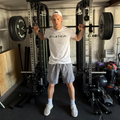




You don't need a pricey gym membership or pro-level gear to start strength training. An 8-week program with three workouts a week, built around fundamental moves with dumbbells, kettlebells and resistance bands, is all it takes to build strength, add muscle and lock in a training habit. A basic starter setup comes in under $600.

Why Strength Training—and Why at Home?
Strength training is one of the best investments you can make in your health, and the payoff goes way beyond bigger muscles. It improves bone density, stabilizes your joints, raises your resting metabolism, improves your posture and has been shown to help prevent back pain and metabolic disease.
The biggest advantage of training at home is convenience. The number one reason people quit isn't a lack of motivation—it's the hassle of getting to the gym. Training at home takes that excuse off the table.
The good news: you don't need a heavy barbell or a power rack to get started. A kettlebell and a set of resistance bands run under $150; add a pair of adjustable dumbbells and you're at roughly $600 for everything you need to get a complete workout in two to three times a week.
The Minimal Equipment You Need to Get Started
For the first 8 weeks, you only need three things:
1. Dumbbells (Adjustable or a Set)
Dumbbells are the most versatile tool a beginner can own. They let you train your entire body—from biceps curls and overhead presses to lunges and triceps extensions. Adjustable dumbbells save a ton of space and cover a whole range of weights in one pair.
Our pick for beginners: a set that covers 10 to 40 lb per dumbbell. ATLETICA offers ready-made sets like the Polyurethane Round Dumbbell Set I (10–25 lb) or the Round Dumbbell PRO Set 2 (20–40 lb)—both with a straight hard-chrome handle and a durable coating.
2. Kettlebells
Kettlebells are ideal for functional training and explosive movements. Their center of mass sits below the handle, which forces your stabilizer muscles to work harder and opens up moves like swings, goblet squats and Turkish get-ups.
Our pick for beginners: the ATLETICA Neoprene Kettlebell Set Top 3 with 18, 35 and 57 lb bells gives you the three most versatile weights for beginners and intermediate lifters. The 18 lb bell is great for warm-ups and smaller muscle groups, the 35 lb bell for functional movements and the 57 lb bell for heavier strength work.
3. Resistance Bands
Resistance bands are the most affordable and flexible training tool out there. Use them for strength work, mobility, warm-ups and as assistance for pull-ups. If you're brand-new to lifting, bands are a smart first buy—they're easy on your joints and let you learn the movement patterns gently.
Our pick for beginners: the ATLETICA Mini Resistance Bands Set with 5 resistance levels or the Full Set with 9 bands. Both are built to last.

The 8-Week Program: Structure and Principles
Training Frequency
As a beginner, you're best off with full-body workouts on three non-consecutive days a week (e.g., Monday, Wednesday, Friday). Research shows beginners make significant progress with just 1–2 sets per exercise.
Training Volume
- Weeks 1–4: 2 sets per exercise, 10–12 reps
- Weeks 5–8: 3 sets per exercise, 8–12 reps
Intensity
Pick a weight where the last 2–3 reps are tough but still clean. You don't have to train to failure to build muscle—current research shows that getting close to failure is enough.
Exercise Selection
The program is built on six fundamental movement patterns that cover your entire body:
| Movement Pattern | Example Exercise | Target Muscles |
|---|---|---|
| Squat | Kettlebell goblet squat | Legs, glutes |
| Hip Hinge | Dumbbell Romanian deadlift | Hamstrings, glutes |
| Horizontal Push | Push-ups or dumbbell bench press | Chest, triceps |
| Horizontal Pull | Dumbbell row | Back, biceps |
| Vertical Push | Dumbbell overhead press | Shoulders, triceps |
| Core | Plank, dead bug | Abs, lower back |
The 8-Week Program in Detail
Workout A (Day 1)
| Exercise | Sets × Reps (Wk 1–4) | Sets × Reps (Wk 5–8) |
|---|---|---|
| Goblet Squat (Kettlebell) | 2 × 10–12 | 3 × 8–12 |
| Dumbbell Floor Press | 2 × 10–12 | 3 × 8–12 |
| Single-Arm Dumbbell Row | 2 × 10–12 per side | 3 × 8–12 per side |
| Overhead Press (Dumbbells) | 2 × 10–12 | 3 × 8–12 |
| Plank | 2 × 30 sec | 3 × 45 sec |
Workout B (Day 2)
| Exercise | Sets × Reps (Wk 1–4) | Sets × Reps (Wk 5–8) |
|---|---|---|
| Romanian Deadlift (Dumbbells) | 2 × 10–12 | 3 × 8–12 |
| Push-Ups (on Your Knees if Needed) | 2 × 8–12 | 3 × 8–15 |
| Kettlebell Swing | 2 × 12–15 | 3 × 12–15 |
| Lateral Raise (Resistance Band) | 2 × 12–15 | 3 × 12–15 |
| Dead Bug | 2 × 8 per side | 3 × 10 per side |
Workout C (Day 3)
| Exercise | Sets × Reps (Wk 1–4) | Sets × Reps (Wk 5–8) |
|---|---|---|
| Lunges (Dumbbells) | 2 × 10 per leg | 3 × 10 per leg |
| Dumbbell Overhead Press | 2 × 10–12 | 3 × 8–12 |
| Bent-Over Dumbbell Row (Both Arms) | 2 × 10–12 | 3 × 8–12 |
| Biceps Curls (Dumbbells) | 2 × 12–15 | 3 × 10–12 |
| Triceps Extensions (Resistance Band) | 2 × 12–15 | 3 × 10–12 |
Important: rest 60–90 seconds between sets and 2–3 minutes between exercises.
Your 8-Week Progression
Weeks 1–2: Learn the Technique
For the first two weeks, your only focus is good form. Go light, keep every rep controlled and learn the movement patterns. Film yourself or train in front of a mirror.
Weeks 3–4: Add Weight
Once your technique is dialed in, bump the weight up slightly. The goal: the last 2 reps should feel challenging. Overloading is the most common beginner mistake (62.4%), followed by poor exercise technique (22.1%)—so don't progress too fast.
Weeks 5–6: Add Volume
Move up to 3 sets per exercise. Keep the reps in the 8–12 range, and adjust the weight so you can hit the top of that range with clean form.
Weeks 7–8: Consolidate and Test
The last two weeks are about locking in your progress. See whether you can hold—or slightly increase—your weeks 5–6 weights on every exercise. Body positioning is the limiting factor in more than 50% of squats and more than 67% of deadlifts, so check your technique again before you go heavier.

Common Beginner Mistakes and How to Avoid Them
Mistake 1: Starting Too Heavy
Overloading is the number one mistake. Start with a weight that feels almost too easy. You've got 8 weeks—the progress will come.
Mistake 2: Skipping the Warm-Up
Five minutes of warming up with resistance bands or light dumbbells cuts your risk of injury considerably. Not knowing how to perform an exercise raises the risk of injury fourfold.
Mistake 3: Training Inconsistently
Two workouts every week beat four workouts in one week followed by two weeks off. Consistency beats intensity.
Mistake 4: Doing Too Many Exercises
The program deliberately sticks to 5 exercises per workout. More isn't better—especially when you're starting out.
Mistake 5: Ignoring Nutrition
Building muscle takes enough protein (roughly 0.7–1 g per pound of body weight) and enough calories. Without proper fuel, your training won't pay off.
What to Do After 8 Weeks
After your first 8 weeks, you've built a solid foundation. Now you've got several options:
- Go heavier: Once 40 lb dumbbells stop challenging you, expand your setup.
- Move to a barbell: For heavier compound lifts (squats, deadlifts, bench press), a barbell and a power rack are the logical next investment.
- Learn new exercises: Add pull-ups, dips or cable exercises.
- Switch programs: After 8 weeks, a new training stimulus makes sense—for example, a push/pull/legs split.
The ATLETICA R5 series is an ideal entry point into barbell training. The R7 series is the versatile pick for serious garage gym lifters. And the R8 series gives you maximum modularity to grow with you for the long haul.
Frequently Asked Questions
Can I build muscle with just dumbbells?
Yes. You can train every major muscle group with dumbbells. Research shows dumbbell training is just as effective for building muscle as machine training, as long as your intensity and progression are on point.
How long does a workout take?
A session of 5 exercises at 2–3 sets each takes about 30–45 minutes, including warm-up and rest. That's plenty when you're getting started.
Do I need a weight bench?
Not for the first 8 weeks. You can press on a mat or a sturdy chair. An adjustable weight bench opens up a lot more exercises down the road.
What should I eat before and after training?
Before training: a meal with carbs and protein about 1–2 hours beforehand. After training: a protein-rich meal within 1–2 hours. Staying well hydrated is essential.
How often should I increase the weight?
Go up in weight once you can hit the top of the rep range (12) with clean form on every set. That typically happens every 1–2 weeks. Use smaller jumps for upper-body moves (2–5 lb) and bigger ones for lower-body moves (5–10 lb).
Can I do the program with just resistance bands?
Yes, if you're brand-new, the program works with resistance bands alone. You'll hit a plateau sooner, though, because the resistance is limited. By week 4 at the latest, it's time to invest in dumbbells.

The Bottom Line: Just Start—You Need Less Than You Think
The biggest mistake is waiting for the perfect setup. A pair of dumbbells, a kettlebell and a set of resistance bands are all you need for the first 8 weeks. The program is simple on purpose: six fundamental movements, three workouts a week, steady progression.
After 8 weeks, you won't just be stronger—you'll have built a habit that sticks for life. Then you can decide whether to invest in heavier equipment.
Your next step: start with the basic setup of dumbbells, kettlebells and resistance bands. ATLETICA covers all three categories with gear that's built to last and made for everyday training.
Recommended Starter Setup
| Product | Price | Link |
|---|---|---|
| Polyurethane Round Dumbbell Set (10–40 lb) | – | – |
| Neoprene Kettlebell Set Top 3 (18/35/57 lb) | – | – |
| Resistance Bands Full Set (9 bands) | $129 | View bands |
Total investment: less than a year of gym membership—and the gear is yours for good.
Related Guides
- 10 Common Strength Training Mistakes (and How to Avoid Them)
- Garage Gym Under $3,000 2026: The Complete Atletica Setup (Rack + Accessories + App)
- Kettlebell vs. Dumbbell vs. Resistance Band: Which Is Best for Your Training?
- Buying a Barbell in 2026: How to Pick the Perfect Bar for Your Garage Gym
- Smith Machine vs. Free Weights: Which Is Better for Your Garage Gym?
- Smith Machine Exercises: The 15 Best Moves for Your Garage Gym