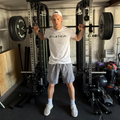




Functional training is training built around the natural movement patterns you use every day: lifting, carrying, pushing, pulling and rotating. It works several muscle groups at once and builds strength, stability, coordination and mobility. Unlike isolated machine work, it prepares your body for real-world demands. And the research is clear: functional training measurably improves movement quality and lowers your risk of injury.
"Functional training" has become one of the most overused terms in fitness. Almost every gym advertises it, and almost every coach calls their program functional. So what's really behind it, and how is it different from traditional strength training?

What Is Functional Training? The Definition
Functional training is a way of training that systematically prepares your body for the demands of everyday life and sports. The focus is on movement patterns, not individual muscles.
In one sentence: functional training improves how your body performs in daily life and in sports, using exercises that mimic natural movement patterns and involve multiple joints and muscle groups at the same time.
It started out in physical therapy and rehab. From there, the concept made its way into sports, where it's used to improve sport-specific performance. Functional training boosts mobility, joint stability, strength, speed and motor coordination by retraining how your nervous system controls movement.
The 7 Movement Patterns of Functional Training
Functional training is built on seven fundamental movement patterns that cover everything you do in daily life:
| Movement pattern | Everyday example | Sports example |
|---|---|---|
| Squat | Getting up from a chair, sitting down on the toilet | Jumping power, first-step acceleration |
| Hinge | Picking something up off the floor | Deadlift, jumping |
| Push | Pushing open a heavy door, lifting a box overhead | Throwing, punching |
| Pull | Carrying grocery bags, climbing | Rowing, pull-ups |
| Rotate | Handing something to someone beside you | Golf swing, tennis |
| Carry | Carrying a case of water | Rucking, contact sports |
| Walk/Run | Climbing stairs, going for a walk | Sprinting, endurance |
These patterns mirror exactly what you do every day: getting up, climbing stairs, carrying groceries, picking something up off the floor, putting something heavy on a high shelf.
The Science: What the Research Shows
Functional training isn't a fad without substance. The research behind it is solid. Here are the key findings from systematic reviews and meta-analyses:
Better Movement Quality (FMS Score)
An integrative review with 162 participants compared functional training with traditional sports training. The result: functional training came out 5.61 points ahead on the Functional Movement Screen (FMS) and delivered a 23.12-point improvement in athletic performance over the comparison group. Functional strength training raised the average FMS score significantly, from 13.68 to 16.63 points.
A meta-analysis of 40 studies with 1,604 athletes confirmed it: targeted training interventions, especially strength training, neuromuscular training and functional training, consistently raised FMS scores. Core stability training showed the largest effect size (MD: 2.89).
Better Physical Performance
A meta-analysis of 19 high-quality studies with 911 healthy participants looked at the effects of high-intensity functional training (HIFT). The results:
- Strength: effect size 1.380 (p < 0.001)
- Power/explosiveness: effect size 1.320 (p < 0.001)
- Speed: effect size 3.093 (p < 0.001)
- Endurance: effect size 1.802 (p < 0.001)
- Agility: effect size 2.086 (p < 0.001)
A systematic review of 28 studies covering 819 athletes from 12 countries came to the same conclusion: functional training significantly improves athletes' physical and technical performance.
Lower Injury Risk
Functional training is more effective than traditional methods at reducing the risk of musculoskeletal injuries. The reason: by improving neuromuscular coordination and movement quality, it makes your body more resilient, not just in your workouts but in everyday life.
Body Composition
An eight-week study with young, untrained adults found that functional training led to a significant drop in body fat percentage (p = 0.008) and significant improvements in every dynamometer-measured strength parameter (p < 0.01).
Functional Training vs. Traditional Strength Training: The Differences
| Criterion | Functional training | Traditional strength training |
|---|---|---|
| Focus | Movement patterns | Individual muscles |
| Planes of motion | Multiplanar (3D) | Mostly sagittal (1D) |
| Joints involved | Multi-joint | Often single-joint |
| Muscle activation | Entire kinetic chain | Localized |
| Goal | Real-world and athletic performance | Muscle growth, max strength |
| Equipment | Kettlebells, bands, medicine balls, bodyweight | Machines, barbells, dumbbells |
| Carryover to daily life | High | Low to moderate |
Traditional strength training isolates muscle groups and often works in a single plane of motion. Functional training ties multiple joints, planes of motion and muscle groups together into one coordinated pattern. The kinetic chain, meaning how your upper body, lower body and core work together, is front and center.

The Best Functional Training Exercises
Bodyweight Basics (No Equipment)
| Exercise | Movement pattern | Target muscles |
|---|---|---|
| Squat | Squat | Legs, glutes, core |
| Lunge | Squat (single-leg) | Legs, glutes, balance |
| Push-up | Push | Chest, shoulders, triceps, core |
| Plank | Anti-rotation | Core, shoulders |
| Glute Bridge | Hinge | Glutes, hamstrings |
| Step-up | Squat/walk | Legs, glutes, balance |
Kettlebell Exercises
| Exercise | Movement pattern | Why it works |
|---|---|---|
| Kettlebell Swing | Hinge | Explosive hip extension, entire posterior chain |
| Goblet Squat | Squat | Front-loaded position fires up your core |
| Turkish Get-up | Multiplanar | Full-body coordination, shoulder stability |
| Kettlebell Clean & Press | Pull + push | Strength endurance, shoulders |
Plyo Box Exercises
| Exercise | Movement pattern | Why it works |
|---|---|---|
| Box Jump | Jump | Explosive and reactive power |
| Step-up | Squat/walk | Single-leg strength, balance |
| Box Squat | Squat | Controls depth, grooves technique |
| Decline Push-up | Push | More chest activation |
Battle Rope Exercises
| Exercise | Movement pattern | Why it works |
|---|---|---|
| Alternating Waves | Rotate/carry | Shoulders, core, conditioning |
| Double Slams | Hinge + push | Full body, explosiveness |
| Rope Pulls | Pull | Back, biceps, grip strength |
| Lateral Whips | Rotate | Lateral core stability |
What Equipment Do You Need for Functional Training?
Functional training works with minimal equipment, but the right tools dramatically expand what you can do.
Kettlebells: The Foundation
Kettlebells are the most versatile functional training tool. Because the center of mass sits below the handle, they hit your core harder than any other type of free weight.
Our pick: the Neoprene Kettlebell Set Top 3 (18, 35 and 57 lb) covers every basic functional movement. Every ATLETICA kettlebell has the same 1.6" handle diameter, no matter the weight. That keeps the feel consistent and makes switching between bells seamless.
Plyo Boxes: Explosive Power and Balance
A plyo box is a must for jump training, step-ups and single-leg stability work.
Our pick: the Plyo Box Classic is made from 3/4" plywood with interlocking construction and internal bracing. Just flip it to get three jump heights in one box (20", 24" and 30"), and it's rated for up to 440 lb. The Plyo Box PRO adds a neoprene cover over foam padding, which cuts down on the classic scraped shin from hitting a wooden edge. And the PlyoBox Modular gives you four stackable boxes (24", 18", 12" and 6") for maximum flexibility.
Battle Ropes: Strength Endurance and Conditioning
Battle ropes deliver an effective full-body workout that builds muscle and improves endurance. The dynamic movements work your entire body and boost strength endurance and coordination. An eight-week study found that battle rope interval training significantly improved cardiometabolic risk factors in adults with overweight, including lower total and LDL cholesterol and a higher VO2 max. Nine weeks of battle rope training had a positive effect on fat loss, lean mass and explosive power.
Our pick: the HRX Battle Rope (50 ft) is ideal for dynamic strength and conditioning work.
More Functional Training Gear from ATLETICA
| Product | Use | Why it works |
|---|---|---|
| Sandbag 22–66 lb | Carrying, lifting, throwing | Shifting load maxes out core engagement |
| Power Bag sets | Throwing, carrying, slamming | Multiple weights for progression |
| HRX Wall Balls | Throwing, squat + push | Full-body explosiveness |
| Suspension Trainer | Bodyweight exercises | Instability training, core |
| Multi-Grip Pull-Up Bar | Pulling, pull-ups | Multiple grip options |
| Foldable Dip Station | Pushing | Space-saving, versatile |
| Parallettes | Support holds, handstands | Easy on the wrists |
ATLETICA's functional training range covers everything from plyo boxes and battle ropes to wall balls and suspension trainers.

A 4-Week Beginner Plan for Functional Training
Weeks 1–2: The Basics
3 sessions per week, 30–40 minutes
| Exercise | Sets × reps |
|---|---|
| Goblet Squat (kettlebell) | 3 × 10 |
| Kettlebell Swing | 3 × 12 |
| Push-up | 3 × 8–12 |
| Step-up (plyo box) | 3 × 10 per leg |
| Plank | 3 × 30 sec |
Weeks 3–4: Turning Up the Intensity
3–4 sessions per week, 40–50 minutes
| Exercise | Sets × reps |
|---|---|
| Kettlebell Swing | 4 × 15 |
| Goblet Squat | 4 × 10 |
| Box Jump (plyo box) | 4 × 6 |
| Battle Rope Alternating Waves | 4 × 30 sec |
| Turkish Get-up (light) | 3 × 3 per side |
| Plank with Leg Lift | 3 × 8 per side |
Frequently Asked Questions
What exactly is functional training?
Functional training is an approach that mimics natural movement patterns and involves several muscle groups and joints at once. It improves strength, stability, coordination and mobility for daily life and sports.
Who is functional training for?
Functional training works for every fitness level, from beginners to pros. Every exercise can be scaled to where you are right now. It's especially valuable if you want to move better in everyday life or prevent injuries.
What are typical functional training exercises?
Typical exercises include squats, lunges, deadlifts, push-ups, planks, kettlebell swings, box jumps and rotational movements.
What equipment do I need for functional training?
Your own bodyweight is enough to get started. For more variety, add kettlebells, a plyo box, battle ropes, resistance bands and medicine balls. ATLETICA makes built-to-last gear across these categories.
Can I do functional training at home?
Yes. Plenty of functional training exercises need no equipment at all. Add kettlebells, resistance bands and a plyo box and you can expand your training dramatically, all in a small corner of your garage or spare room.
How often should I do functional training?
If you're just starting out, 2–3 sessions per week is ideal. More experienced lifters can train 3–4 times a week. Just make sure you get enough recovery between sessions.
What's the difference between functional training and cross-training?
Cross-training combines functional training with high intensity, constantly varied workouts and often a competitive element. Functional training is the broader approach; cross-training is one of many ways to put it into practice. If you're training for functional fitness races, you'll find the gear you need, like sleds, wall balls and sandbags, in ATLETICA's HRX collection.
Is functional training good for older adults?
Yes, especially so. Functional training improves exactly the abilities that matter more as you age: getting up from a chair, climbing stairs, balance and fall prevention. Every exercise can be scaled to the individual.

The Bottom Line: Functional Training Is More Than a Trend
Functional training isn't a buzzword. It's a science-backed approach with measurable results. The research shows that functional training improves movement quality, increases strength, power, endurance and agility, and reduces your risk of injury.
The three key takeaways:
- Movement patterns over muscles. Functional training trains your body as a whole, not isolated muscles.
- The evidence is strong. Meta-analyses with more than 900 participants show significant effects on strength, power, speed and endurance.
- You don't need much gear. Kettlebells, a plyo box and a battle rope cover 90% of all functional exercises.
Your next step: Start with the 4-week beginner plan in this article. ATLETICA has every tool you need in TÜV-tested quality, from kettlebells and plyo boxes to battle ropes.
Recommended Functional Training Setup
| Product | Price | Link |
|---|---|---|
| Neoprene Kettlebell Set Top 3 (18/35/57 lb) | – | – |
| Plyo Box Classic (3 heights) | $145 | See the box |
| HRX Battle Rope 50 ft | $119 | See the rope |
| Suspension Trainer | $55 | See the trainer |
Together, these four make up a complete functional training setup for your garage gym.
Further Reading
- Kettlebell vs. Dumbbell vs. Resistance Band: Which Is Best for Your Training?
- Cable Exercises: The 15 Best Moves for Chest, Back, Shoulders and Arms
- Gym Floor Protection 2026: What Really Matters in Mats and Flooring
- Garage Gym Under $3,000 2026: The Complete Atletica Setup (Rack + Accessories + App)