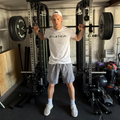




There's no "better" — only the right tool for your goal. Dumbbells are your best bet for targeted muscle building, precise progression and getting started. Kettlebells pull ahead when you want to build strength, conditioning and coordination at the same time — especially for your back and posterior chain. Resistance bands are the most versatile add-on for warm-ups, rehab, mobility and functional training — but on their own, they only take your strength training so far.
Research backs this up: for roughly 90% of lifters, kettlebells offer no measurable advantage over dumbbells when the goal is muscle growth, general fitness or strength. Still, each of the three tools has one specific strength the others can't replace.

Head to Head: The Three Tools Compared
| Criteria | Kettlebell | Dumbbell | Resistance Bands |
|---|---|---|---|
| Weight distribution | Center of mass below the handle (asymmetric) | Evenly split on both sides (symmetric) | No weight — resistance comes from stretch |
| Resistance curve | Constant (the weight never changes) | Constant | Ascending (more stretch = more resistance) |
| Freedom of movement | High (thanks to the handle shape) | Very high (open system) | Maximum (works in every direction) |
| Coordination & stability | Very high (offset load fires up your core) | High (single-arm work possible) | Moderate to high (depends on the exercise) |
| Muscle-building potential | High (but limited by big weight jumps) | Very high (fine progression) | Moderate (limited resistance) |
| Strength-building potential | High (especially for power) | Very high (heavier loads possible) | Low to moderate |
| Joint-friendliness | Moderate | Moderate | Very high |
| Injury risk with poor technique | Elevated (ballistic movements) | Low | Very low |
| Space needed | Very little | Little to moderate | Minimal |
| Portability | High | Moderate (heavy) | Maximum |
| Cost (basic setup) | Moderate to high | Moderate | Very low |
| Best for | Functional training, power, back | Muscle building, isolation, beginners | Warm-ups, rehab, mobility, supplemental work |
Sources: comparison data from Fitbook, RTL, OPTIMALEFITNESS and the ATLETICA blog
Kettlebell: The Functional Powerhouse
A kettlebell is a cast-iron ball with a handle, and its center of mass sits below your hand. That seemingly small design difference completely changes the biomechanics of your training.
Kettlebell Pros
The offset load hits your core harder. Because the center of mass sits below the handle, your trunk muscles constantly have to resist rotation. That makes kettlebell work some of the most effective core training there is.
Built for explosive, functional movement. The kettlebell swing may be the single most effective exercise for your posterior chain. One study found that kettlebell swing training improved half-squat 1RM by about 9.8% and vertical jump height by up to 19%.
Strength and conditioning in one. Swings, snatches and clean & jerks tax your cardiovascular system and your muscles at the same time. You save training time and build your conditioning along the way.
Easy on your back. An eight-week workplace study showed that kettlebell training can reduce neck, shoulder and back pain while increasing back-extensor strength.
Kettlebell Cons
- Technique has to be learned — ballistic moves like swings and snatches raise your injury risk if your form is off
- Weight jumps are often too big — kettlebells usually go up in roughly 9-lb steps, which makes fine progression tough
- Limited for isolation — for targeted biceps or triceps work, dumbbells are simply more practical
- The swap doesn't work both ways — many ballistic moves can only be done with kettlebells, but not every dumbbell isolation exercise works well with the bell shape
ATLETICA Kettlebell Picks
| Product | Description | Highlights |
|---|---|---|
| Neoprene Kettlebell Set Basic (18/26/35/44/53 lb) | Five kettlebells for beginners | Roughly 9-lb jumps cover a wide training range — ideal for learning the fundamental movements |
| Neoprene Kettlebell Set Top 3 (18/35/57 lb) | The three most versatile weights | 18 lb for warm-ups and conditioning, 35 lb for functional compound lifts, 57 lb for building strength |
| Neoprene Kettlebells, single (9–70 lb) | Single bells in roughly 9-lb steps | TÜV-tested to REACH standards, the same 1.6" handle diameter at every weight, neoprene coating |
Every ATLETICA neoprene kettlebell has the same 1.6" handle diameter, no matter the weight. That gives you a consistent feel and makes switching between bells seamless.

Dumbbell: The Classic for Targeted Muscle Building
A dumbbell is a short, one-handed weight with symmetric weight distribution. It's the most versatile and most widely used piece of strength equipment out there.
Dumbbell Pros
Precise muscle building. Dumbbells let you load individual muscle groups very precisely, which makes them ideal for targeted hypertrophy and isolation work.
Fix muscle imbalances. Because each side works independently, you can spot and correct imbalances between sides.
Fine progression. Dumbbells come in small weight increments (5 lb or less with adjustable systems). That lets you apply progressive overload in small steps — the key to long-term muscle growth.
Beginner-friendly. The symmetric load and controlled movement make dumbbells the easiest way to get started. There's simply less to think about than with kettlebell swings.
More loading potential. You can move more weight under control with dumbbells than with kettlebells, which gives them the edge for heavy strength work and hypertrophy.
Dumbbell Cons
- Less functional — the focus is on isolation, not mobility and coordination
- Limited top weight on adjustable systems — beginner sets often max out at 40–60 lb per dumbbell
- Space — a full set needs a dumbbell rack or plenty of shelf space
- Not built for explosive work — ballistic moves only work to a limited extent with dumbbells
ATLETICA Dumbbell Picks
| Product | Description | Highlights |
|---|---|---|
| Polyurethane Round Dumbbell Set I (10–25 lb) | Starter set for targeted muscle building | PU coating (odor-free and tougher than PVC), medium knurling, weight tolerance of 3% max |
| Round Dumbbells PRO Set 1 (5–25 lb) | Beginner set with the finest increments | Every pair in 5-lb steps — ideal for progressive overload |
| Round Dumbbells PRO Set 6 Complete (10–120 lb) | The complete premium set | Every weight from 10 to 120 lb, in 5-lb steps up to 40 lb, plus Add-On Flex Plates for jumps of just 0.5–2 lb |
Add-On Flex Plates are a real game changer: they let you go up in tiny increments — perfect for progressive overload on isolation work or whenever the usual 5-lb jump is too big.

Resistance Bands: The Underrated Training Tool
Resistance bands are elastic bands made of latex or rubber that create resistance as they stretch. The farther you stretch them, the higher the resistance — and that's the fundamental difference from weights.
Resistance Band Pros
Variable resistance curve. With weights, the load stays constant; with a band, resistance climbs as it stretches. That makes bands ideal for lifts where your strength curve increases through the rep — like the bench press or squat.
Resistance in every direction. Free weights work mainly vertically (gravity). Bands create resistance in any direction — horizontal, diagonal, rotational. That opens up training stimuli you can barely hit with weights.
Joint-friendly and rehab-ready. Elastic resistance is much easier on your joints and tendons than heavy weights. Electromyography (EMG) studies show muscle activation comparable to free weights — with a lower risk of injury.
Maximum portability. Bands fit in any gym bag. Use them at home, at the office, on vacation or at the park.
Perfect for warm-ups and activation. Before you lift, bands can wake up the muscles that get neglected in everyday life — especially your rotator cuff, glutes and core.
Pull-up assistance. Use bands to assist your pull-ups and work your way step by step to unassisted reps.
Resistance Band Cons
- Limited resistance — not enough for heavy strength training with max loads
- Hard to quantify — you never know exactly how many pounds you're moving, which makes progression and programming harder
- Less muscle-building potential — for maximum growth, weights win because they allow heavier loads and more precise progression
- Technique can suffer — especially for beginners, the changing tension can pull your posture out of position
- Wear and tear — bands lose elasticity over time and need to be replaced
ATLETICA Resistance Band Picks
| Product | Description | Highlights |
|---|---|---|
| Mini Resistance Bands Set | Five strengths from light to heavy | 12" x 2", top-quality 100% latex — ideal for warm-ups, activation and mobility |
| Resistance Bands Heavy Set | Stronger loop bands for strength work | Works in every direction — for strength training, pull-up assistance and functional training |
| Resistance Bands Full Set (9 bands) | Every strength in one set | The full range from warm-up to heavy work — single bands also available from $15 |
The ATLETICA blog explains where bands really earn their keep: activation (the mind-muscle connection during your warm-up), working on weak points (band-assisted squats in the rack) and athletic training (speed and agility work).

The Science: What Does the Research Say?
The research is clear: for most training goals, all three tools work — they just have different strengths.
Muscle Growth (Hypertrophy)
For roughly 90% of lifters, kettlebells offer no measurable advantage over dumbbells when the goal is muscle growth or general strength. Dumbbells often give you even more exercise variety and finer progression.
Max Strength
Dumbbells let you handle heavier loads and therefore drive bigger strength gains. Barbells beat them here, but dumbbells are the best compromise between loading potential and single-arm work.
Power and Explosiveness
Kettlebells win this one hands down. Kettlebell swings are among the most effective exercises for explosive strength — studies show significant gains in jumping ability and rate of force development.
Rehab and Joint Health
Resistance bands come out on top. They deliver comparable muscle activation with a much lower risk of injury and have been a rehab staple for decades.
The Right Combo for Your Goal
Goal: Muscle Building and Targeted Strength
Our pick: dumbbells as your foundation + kettlebells for functional work.
The ATLETICA Round Dumbbells PRO series gives you the finest weight increments, and Add-On Flex Plates let you micro-load for progressive overload. Add a kettlebell for swings and goblet squats to strengthen your posterior chain and core.
Goal: Functional Training and Everyday Fitness
Our pick: kettlebells as your foundation + resistance bands for mobility.
The Neoprene Kettlebell Set Top 3 (18/35/57 lb) covers all the functional basics. Add mini resistance bands for warm-ups, activation and mobility work.
Goal: Getting Started on a Tight Budget
Our pick: dumbbells + resistance bands.
The Polyurethane Round Dumbbell Set I (10–25 lb) plus a Mini Resistance Bands Set keeps the cost low and covers every fundamental exercise for your first 6–12 months.
Goal: Rehab or Joint Issues
Our pick: resistance bands as your primary tool.
ATLETICA Resistance Bands give you joint-friendly strength training with muscle activation comparable to free weights — ideal after an injury or if you deal with chronic joint pain.
Goal: Fully Equipped Garage Gym
Our pick: combine all three.
| Tool | ATLETICA Product | Role in Your Training |
|---|---|---|
| Dumbbells | Round Dumbbells PRO Set 1 (5–25 lb) | Targeted muscle building, isolation, progression |
| Kettlebell | Neoprene Kettlebell Set Top 3 (18/35/57 lb) | Functional training, power, core |
| Resistance bands | Mini Resistance Bands Set + Resistance Bands | Warm-ups, mobility, rehab, supplemental work |
Together, they give you a complete foundation.
Frequently Asked Questions
Can I build as much muscle with kettlebells as with dumbbells?
Yes — for most lifters, the two are on par. Research shows no measurable advantage for kettlebells when it comes to muscle growth. Dumbbells do give you finer progression and more exercise variety for isolation work.
Are resistance bands enough to build muscle?
For beginners and moderate intensity: yes. For advanced strength training: no. The resistance is limited and hard to quantify. Bands are a valuable addition, but not a full replacement for weights.
Which tool is best for beginners?
Dumbbells are the easiest place to start — symmetric load, controlled movement, low injury risk. Kettlebells demand more technique, especially for ballistic moves. Resistance bands are great for the first few weeks but quickly hit their limits.
Can I do kettlebell exercises with dumbbells?
Most of them, yes — but not all. Dumbbell exercises can almost always be done with kettlebells, but many ballistic kettlebell moves work only partially with dumbbells, or not at all.
Which is better for your back: kettlebell or dumbbell?
Kettlebells have a slight edge here. The offset load activates your deep stabilizing muscles more, and studies show kettlebell training can reduce back pain.
What's the best way to combine all three?
A proven approach: dumbbells for your main strength lifts (bench press, overhead press, rows), kettlebells for functional work (swings, goblet squats, Turkish get-ups) and resistance bands for warm-ups, activation and mobility.

The Bottom Line: The Right Tool for Your Goal
| If you want to... | choose... |
|---|---|
| build muscle in a targeted way | Dumbbells |
| develop functional strength and power | Kettlebells |
| focus on rehab, mobility or warm-ups | Resistance bands |
| build a complete garage gym | All three combined |
| get started without spending much | Dumbbells + resistance bands |
The honest answer: most lifters get the most out of a combination. Dumbbells as your foundation for strength and muscle, a kettlebell for functional and explosive work, and resistance bands for warm-ups, mobility and rehab.
Next step: start with the tool that matches your main goal. ATLETICA covers all three categories with German-engineered quality — built to last and made for everyday training.
Recommended Combo Setup
| Product | Price | Link |
|---|---|---|
| Polyurethane Round Dumbbell Set I (10–25 lb) | — | — |
| Neoprene Kettlebell Set Top 3 (18/35/57 lb) | — | — |
| Mini Resistance Bands Set | — | — |
Together, a complete foundation for strength, function and mobility.