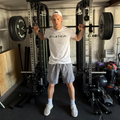




A power rack is the safest, most versatile investment you can make for your garage gym—as long as it fits your space, your training goals and your budget. The ten questions ATLETICA customers ask most before they buy come down to space, ceiling height, safety, stability, expandability, assembly, maintenance and the difference between the R5, R7 and R8 series. This guide answers all of them, with real numbers, real product specs and practical tips.

Question 1: How much space do I really need for a power rack?
Most people underestimate the space a rack takes up—especially the depth. A power rack that looks great on paper can suddenly feel way too big once it's in a real garage or basement.
A realistic rule of thumb:
| Dimension | Recommended minimum |
|---|---|
| Width | about 51–59" |
| Depth | about 47–71" (depending on model and lat pulldown) |
| Height | about 87–93" |
Depth is almost always the limiting factor. The most compact option in the ATLETICA lineup is the R8 Bradley EXO with a 16.5" crossmember depth: it needs only about 51–55" of total depth, so it fits in plenty of smaller garages and basements.
Keep in mind: these are approximate figures that include the usual attachments (J-hooks, safety spotter arms, lat pulldown). On top of that, plan for at least 20–28" of clearance in front of and behind the rack.
The R8 BlackHawk with its integrated lat pulldown has a total depth of about 71"—workable in most garages. The R7 EVO Fighter is often a bit easier to fit and more compact than the big R8 builds, especially if you're after an all-in-one setup with a Smith machine.
ATLETICA resource: our guide "How Much Space Do I Need for a Power Rack? The Best Compact Models from Atletica" lists the exact dimensions of every compact model.
Question 2: What's the minimum ceiling height I need?
Ceiling height is the factor people overlook most—and the one you can least fix after you've bought the rack.
The rule of thumb: when you do pull-ups, your head and upper body come up above the top of the rack. So add at least 12" to the rack height.
The numbers:
| Activity | Minimum ceiling height |
|---|---|
| Big lifts (squats, bench press) | 87–91" (7'3"–7'7") |
| Pull-ups with full extension | 94–98" (7'10"–8'2") |
| Fitting an 89" rack (no pull-ups) | 94"+ (7'10"+) |
Full-height ATLETICA racks stand roughly 87–91" tall, depending on the model. In a basement with a low ceiling, that gets tight. The compact versions—the R5 at 77" and the R7 at 80" (like the R7 Root and R7 Base Plate Loaded)—are the better choice for low rooms.
Tip: if your ceiling is lower than 87" (7'3"), skip pull-ups in the rack and mount a separate wall pull-up bar somewhere that has the clearance.

Question 3: Is a power rack safe if I train alone?
Yes—that's exactly what a power rack is built for. Adjustable safety bars (or safety spotter arms) catch the barbell when you miss a rep. That matters most on squats and bench press when you don't have a training partner.
How to set your safety bars:
- For squats: set the safeties just below the bottom position of your squat. You get your full range of motion, but the bar is caught safely if you have to bail.
- For bench press: set the safeties at about chest height, so you can set the bar down without it pinning your ribcage.
The big advantage: you can train to failure without worrying about getting stuck under the bar. That makes your training both more effective and safer.
ATLETICA safety: all R8 power racks are TÜV and GS certified to EN 20957 (Class S) and explicitly approved for commercial use. The R7 series is TÜV certified as well.
Question 4: Do I need to bolt my power rack to the floor?
In most cases, no. A quality power rack with enough weight of its own stays stable without being anchored.
Take ATLETICA as an example: the R8 SoundWave Power Rack weighs about 435 lb on its own. It's so stable that you don't need to bolt it down. If you want to anchor it anyway, you can remove the rubber feet and use the pre-drilled holes.
When anchoring makes sense:
- For high-intensity, dynamic movements (e.g. Olympic lifts, kipping pull-ups)
- For very light racks that don't have enough weight of their own
- On floors where the rack could slide (e.g. smooth concrete)
- When you hang a suspension trainer from the rack
Renting? Bolting into the floor often isn't an option. In that case, a heavy rack is the right choice—it stays put without any anchors.
Question 5: What's the difference between the R5, R7 and R8 series?
The three ATLETICA series differ in stability, steel gauge, modularity and price. Here's how they compare head to head:
| Criterion | R5 series | R7 series | R8 series |
|---|---|---|---|
| Steel tubing | 2" x 2" | 2.75" x 2.75" | 3" x 3" |
| Wall thickness | 14-gauge | 14-gauge | 11-gauge |
| Max. weight capacity | up to 1,500 lb | up to 1,850 lb | up to 3,300 lb |
| Modularity | Good (R5 accessories) | Very good | Maximum (all R8 attachments) |
| Footprint | Very compact | Compact | Medium to large |
| Who it's for | Beginners, tight spaces | Serious garage gyms | Advanced lifters & pros |
| Price range | — | from $905 | from $855 |
| Best for | Small rooms, first rack | Most garage gyms | Maximum room to grow |
Important: the systems aren't cross-compatible. You can't upgrade from R5 to R7 or from R7 to R8 later. If you want maximum expandability over the long run, start with the R8 series right away.
The decision in one sentence each:
- R5: compact, affordable, for beginners short on space
- R7: the versatile all-rounder with the best value for money
- R8: premium, fully modular, built to grow with you
Question 6: Is a budget power rack in the $400–$700 range good enough?
This is the question ATLETICA hears most. The honest answer: for most people, a premium rack pays off far more in the mid to long term—mainly for safety and durability reasons.
What to watch out for with a budget rack:
- Weight capacity: entry-level racks are often rated for only 1,100–1,500 lb. For heavy training with 330 lb+ on the bar, that's cutting it close.
- Steel gauge: usually just 14- to 16-gauge steel. Under dynamic loads, the rack can wobble or even bend.
- Certifications: budget racks rarely carry TÜV or GS certification.
- Spare parts: after a few years, replacement parts are often no longer available.
The ATLETICA take: the R5 Base Power Rack gives you 2" x 2" steel tubing and a 1,500 lb weight capacity—solid for beginners. If you train hard and plan to keep your rack for years, though, you're better off with the R7 series (from $905) or the R8 series (from $855).
Our guide "Cheap Power Rack or Premium? The Honest 2026 Comparison" goes into this question in detail.
Question 7: Can I expand my power rack later?
Yes—but only within the same series. That's one of the most important points to consider before you buy.
ATLETICA modularity:
- R5 series: expandable with R5 accessories (J-hooks, safety spotter arms, dip station, landmine)
- R7 series: expandable with a wide range of R7 attachments (e.g. Jammer Arms, safety straps, dip station, landmine, weight storage pins, band pegs)
- R8 series: fully expandable—compatible with every R8 attachment, including cable machines, Smith machine, lat pulldown, monolifts and much more
Take the R8 as an example: the R8 Bradley combines the stability of a power rack with the versatility of a cable station. It's built on the R8 platform and can take a 190 lb cable stack without any structural changes—on the right or left side, with a 16.5" or 30.5" crossmember depth.
The key advice: if you know you'll want more attachments or heavier training in a year or two, start with the R8 series right away. You can't upgrade between series later.

Question 8: How long does assembly take—and can I do it alone?
Yes, you can—even on your own. ATLETICA R8 power racks are designed to be fully assembled in 90–120 minutes with two people, or in 120–150 minutes solo.
Assembly at a glance:
- Prep (15 min): lay out your tools, sort the parts
- Stand up the uprights (12–15 min)
- Assemble the rack (60–90 min)
- Install attachments (depending on your setup)
Tools you'll need: the included Allen wrench covers almost everything. A rubber mallet and a second person help with a few steps—but they're not strictly necessary.
ATLETICA support: if you get stuck during assembly, the ATLETICA USA team in Corona, CA is there to help at contact@loganitemsxv.shop. You also get step-by-step instructions and the free ATLETICA Training App.
Tip: build the rack where it's going to stay—moving a fully assembled rack is a lot more work.
Question 9: How do I care for and maintain my power rack?
A power rack needs very little maintenance—but a few regular checks add years to its life.
Weekly:
- Check bolts and connections: make sure every bolt is tight. Loose connections lead to wobbling and premature wear.
- Visual check: listen for unusual noises and look for cracks or bent parts.
Monthly:
- Cleaning: wipe off sweat and dust with a soft cloth and lukewarm water. Avoid harsh cleaners and bleach.
- Lubricate moving parts: on cable machines and lat pulldowns, treat the metal guide rods with PTFE (Teflon) grease to cut friction and noise.
Yearly:
- Inspect cables and pulleys: on cable systems, check the cables for wear and replace them if needed. Check the pulleys for play and smooth rotation.
ATLETICA quality: a double powder coat protects the steel from rust for the long haul, and the hardware is high-strength and rust-resistant.
Question 10: Is it worth buying a used power rack?
Yes—a used power rack can be a great deal. Steel doesn't wear out sitting in a garage. A quality rack that cost $1,000 new often sells used for $400–$500, in practically the same condition.
What to check when buying used:
- Welds: look for cracks or porosity—especially at the main joints.
- Uprights: make sure they aren't bent or warped.
- Rust: surface rust is usually no big deal; deep rust on load-bearing parts is a red flag.
- Completeness: missing J-hooks, safety bars or hardware can get expensive to replace.
- Weight capacity: ask for the model name and its max load rating.
ATLETICA on the used market: used ATLETICA racks are hard to find—a sign that owners hang on to them. If you do find one, note the serial number and contact our support team to check parts availability.
The best value: a used commercial rack in 11-gauge steel, built for gym use and overbuilt for a garage gym—at a fraction of the new price.

All 10 Questions at a Glance
| Question | Short answer |
|---|---|
| 1. Space? | At least 51" x 47" plus 20–28" of clearance |
| 2. Ceiling height? | 7'3"–7'7" for the big lifts, 7'10"+ for pull-ups |
| 3. Safe solo? | Yes—the safety bars catch the barbell |
| 4. Bolt it down? | Usually not necessary if the rack is heavy enough |
| 5. R5 vs. R7 vs. R8? | R5 = compact, R7 = all-rounder, R8 = premium modular |
| 6. Budget or premium? | Premium pays off more in the mid to long term |
| 7. Expand later? | Yes, but only within the same series |
| 8. Assemble solo? | Yes, in 120–150 minutes—support available |
| 9. Maintenance? | Check bolts weekly, clean monthly |
| 10. Buy used? | Yes—steel doesn't wear out; check the welds |
Your Next Step
Still not sure which series and configuration is right for you? ATLETICA offers a free 1-on-1 consultation with our experts. You can also reach the ATLETICA USA team in Corona, CA at contact@loganitemsxv.shop.
The three key takeaways:
- Measure your space and ceiling height before you buy. Depth is almost always the limiting factor—not width.
- The series decides your future. R5, R7 and R8 aren't cross-compatible. If you want to keep growing, start with R8.
- Safety is the number-one reason to get a power rack. Safety bars let you train hard without a spotter—that's the big advantage over a basic squat stand.
Further Reading
- Which Power Rack Fits My Garage Gym? A Decision Guide Based on Space, Training Goals and Budget
- R8, R7 or R5? The Big Atletica Power Rack Series Comparison 2026
- How Much Space Does a Home Gym Really Need? The Complete Space Planning Guide
- R8 Bradley EXO Review: An In-Depth Look at ATLETICA's Modular Power Rack
- R7 EVO Fighter | Power Rack Test 2026 – The Best All-Rounder for Your Garage Gym?
- Gym Floor Protection 2026: What Really Matters in Mats and Flooring
- Smith Machine Buying Guide 2026: How to Choose the Right One for Your Garage Gym