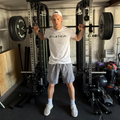




A good Garage Gym isn't about how many machines you own — it's about how well the setup is thought through.
The Power Rack is the heart of it. Position it properly as your central training station and build the rest of the gym sensibly around it, and you'll end up with a far more effective and more enjoyable training space than you would with a pile of single-purpose machines.
In this guide I'll show you how to design your Garage Gym strategically around a modular Power Rack.

Why the Power Rack is the ideal central station
A modular Power Rack (especially from the R7 and R8 series) works brilliantly as your centerpiece, because it:
- Lets you perform most of the big basics safely (squats, bench press, pull-ups, overhead press and so on)
- Can take on more and more functions through add-ons (cable pulley, Lat Pulldown, Smith Machine, Jammer Arms and more)
- Serves as the physical and visual anchor point in the room
- Can replace or complement most other equipment over the long run
Instead of spreading your budget across a lot of separate machines, you invest in one strong central station first and grow the gym organically around it.
How to plan your Garage Gym around the rack
1. Getting the rack position right
Don't just park the rack anywhere. The best position is usually:
- With enough space in front of and behind the rack (so you can bail safely and move freely)
- As central as possible, or at least positioned so you can work from several sides
- With good lighting and ideally near a wall (for storage and cable management)

2. The most important additions to your central station
|
Addition |
Why it matters |
Recommendation |
|
Adjustable bench |
Essential for bench press and plenty of other movements |
Good build quality with a wide adjustment range |
|
Storage solutions |
Keep the space tidy and safe |
Best mounted right on or next to the rack |
|
Flooring |
Protects the floor and gives you solid grip |
Rubber mats or dedicated gym flooring |
|
Lighting |
Better visibility and more motivation |
Bright, glare-free lighting above the rack |
|
Mirror (optional) |
Form checks, plus it makes the room feel bigger |
Especially useful in small rooms |
|
Extra storage |
Wall racks or mobile solutions |
3. Optimize the flow of movement
Plan your walking paths around the rack. You should be able to move freely without constantly stepping over equipment. A good layout saves time and raises the quality of your training.
4. Build it up step by step
You don't need everything at once. Start with:
- Power Rack + bench + basic accessories
- Later: storage solutions
- Then: more attachments as you need them (cable pulley, Lat Pulldown and so on)
Modular add-ons: how your central station keeps getting stronger
The big advantage of a modular system (like the Atletica R7 and R8 series) is that you can expand your central station significantly over time:
- A cable pulley module turns the rack into an all-in-one trainer
- A Lat Pulldown option massively expands your pulling work
- Jammer Arms or a landmine open the door to functional training
- Additional safety systems make heavy lifting safer
Step by step, a classic Power Rack becomes a genuine all-in-one training station – without cluttering the room with more big machines.

Example layouts for different room sizes
Small Garage Gym (65–110 sq ft):
A central R7 or compact R8 model + bench + wall rack for barbells + a good mat. Focus on the most important lifts.
Medium Garage Gym (110–160 sq ft):
R7 or R8 at the center + bench + storage on the rack + cable pulley module + an extra wall rack. Already extremely versatile.
Larger setup (160 sq ft and up):
R8 series with several add-ons (cable pulley, Lat Pulldown, storage) + bench + a separate area for dumbbells or cardio. The rack still stays the heart of it.
Checklist: how to build your gym around the Power Rack properly
- Position the Power Rack as your central station (with plenty of room to move)
- Buy an adjustable bench as your first add-on
- Plan storage solutions right on or next to the rack
- Protect the floor with non-slip mats
- Optimize the lighting above the rack
- Test the flow of movement (can you move freely?)
- Only add attachments that genuinely make sense, one at a time
- If you're unsure: get professional advice

Bottom line: one strong center beats a lot of separate machines
The best Garage Gym isn't the one with the most equipment — it's the one with the best structure.
Choose a solid modular Power Rack as your central training station and arrange the rest of your equipment sensibly around it, and you get a flexible, tidy, highly functional gym – one that can grow with you.
That's exactly what systems like the Atletica R7 and R8 series were built for.
Want a custom concept for your Garage Gym?
Then book a free consultation now. We'll analyze your space and your goals and put together a tailored setup around the right central station for you.
→Book your free consultation now
Or explore the right modular systems:
Frequently asked questions
Does the Power Rack really have to be the centerpiece?
Not necessarily in the geometric middle of the room, but it should take on the central role. Most successful Garage Gyms are built exactly this way.
How many add-ons do I actually need?
Very few at the start, usually. Plenty of people begin with rack + bench + basic accessories and don't expand until 6–12 months in.
Is a modular system overkill for a small gym?
No. In a small space, modularity is often the decisive advantage, because one piece of equipment gets you further than several small ones.
Should I buy the rack first or other equipment first?
Almost always the Power Rack first. It's the foundation everything else is built on.