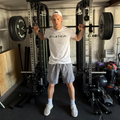




The Smith machine gets a bad rap, and most of it dates back to a time when these machines were still crude. Modern Smith machines like ATLETICA's all-in-one stations run on linear ball bearings, use counterbalanced bars and carry a 1,400 lb weight capacity. The research is clear: train hard enough and muscle activation is on par with free weights. A Smith machine isn't a compromise. It's a tool for focused, safe training.

Myth 1: "The Smith machine makes you lazy."
The claim: Train on a Smith machine and you lean on the guide rails instead of your stabilizers. Over time, that leaves you with a weak core and poor posture.
The reality: Yes, a Smith machine takes some of the load off your stabilizers. But it only makes you "lazy" if it's the only thing you ever train on. The fixed bar path lets you overload the target muscle directly, something free weights can't do as well. That's why experienced lifters use the Smith machine for eccentric overload, paused reps and drop sets, and keep free weights for their main lifts.
The bottom line: The Smith machine is a tool, not a replacement for free weights. Combine the two and you'll make more progress than with either one alone.
Myth 2: "The Smith machine is bad for your joints."
The claim: The fixed bar path doesn't match your natural biomechanics and wears out your joints, especially on squats and bench press.
The reality: It's the other way around. The guided movement prevents sudden load spikes and spreads the force evenly. Studies show the Smith machine is especially well suited to rehab and to lifters with joint issues, because the controlled bar path lowers the risk of injury. The counterbalanced Smith bar on the ATLETICA KSK COMBAT feels almost weightless, which makes it easy to get started and ideal for rehab work.
The bottom line: A Smith machine can be easier on your joints than free weights, as long as your form is solid and your feet are in the right spot.
Myth 3: "You can't build muscle on a Smith machine."
The claim: Without your stabilizers firing, there's no growth stimulus. The Smith machine is only good for beginners and rehab.
The reality: Research says otherwise. A study in the Journal of Strength and Conditioning Research compared Smith machine squats with free-weight squats and found similar hypertrophy when the intensity was high enough. What drives muscle growth is mechanical tension, and you can create just as much of it on a Smith machine as with free weights.
The bottom line: You build muscle on a Smith machine the same way you do anywhere else: train close to failure and keep adding weight over time.

Myth 4: "The Smith machine is only for beginners."
The claim: Advanced lifters and athletes need free weights to keep progressing. The Smith machine is a beginner's machine.
The reality: Advanced lifters use the Smith machine for specific goals that are harder to hit with free weights: eccentric overload, isolation work, drop sets and training safely to failure. The ATLETICA SWAT Smith Machine gives you a 1,400 lb weight capacity and linear ball-bearing guides, so there's plenty of room for heavy loads, even for advanced athletes.
The bottom line: The Smith machine isn't a beginner's machine. It's a specialist tool for targeted training.
Myth 5: "A Smith machine is too expensive."
The claim: For the same money you could get a power rack, a barbell and plates, and you'd be more flexible.
The reality: An all-in-one Smith machine replaces several separate machines: power rack, Smith machine and cable station in one. Do the math: a power rack (from about $900), a Smith machine attachment (about $850) and a standalone functional trainer (from about $2,300) quickly add up to more than $4,000. ATLETICA's KSK Smith machine starts at $3,099 and puts all three on a single footprint.
The bottom line: In the long run, an all-in-one Smith machine costs less than buying separate machines, and it saves space.
Myth 6: "The Smith machine is unnatural."
The claim: A straight, guided bar path doesn't match the way your body naturally moves. That leads to poor loading and bad technique.
The reality: The straight bar path is intentional. It takes complexity out of the lift so you can focus on producing force. For beginners, that's a plus: you can learn the basic movement pattern without getting overwhelmed by balance and stability. Advanced lifters use the Smith machine on purpose for isolation work and rehab.
The bottom line: The Smith machine isn't "unnatural." It's a controlled training tool for specific goals.

Myth 7: "You can't train heavy without a spotter."
The claim: Heavy training takes a partner to catch the bar, and you can't have that on a Smith machine.
The reality: Exactly the opposite. A Smith machine's safety catches stop the bar if you miss a rep. You can train to failure without worrying about getting stuck under the bar. ATLETICA's models give you 9 hook pins (SWAT) or lock-out safety catches (KSK) for maximum safety.
The bottom line: A Smith machine lets you train safely without a spotter, a huge advantage in a garage gym.
The Myths at a Glance
| Myth | Reality |
|---|---|
| "The Smith machine makes you lazy." | It's a tool for targeted training, not a replacement for free weights. |
| "It's bad for your joints." | The guided movement can be easier on your joints, especially in rehab. |
| "You can't build muscle." | Studies show similar hypertrophy when the intensity is high enough. |
| "Only for beginners." | Advanced lifters use it for eccentric overload and isolation. |
| "Too expensive." | It replaces a power rack, Smith machine and cable station, and saves money long term. |
| "Unnatural." | The straight bar path is a controlled tool for specific goals. |
| "No heavy training without a spotter." | Safety catches let you train safely to failure. |

Frequently Asked Questions
Why does the Smith machine get so much hate online?
A lot of the criticism is based on older Smith machines that weren't fully developed yet, with sticky guide rails, limited weight capacity and no safety catches. Modern models like ATLETICA's all-in-one Smith machines run on linear ball bearings, carry 1,400 lb and use counterbalanced bars. The old criticism simply doesn't apply anymore.
Is a Smith machine worth it for a garage gym?
Yes, especially if you train alone, are short on space or put safety first. An all-in-one Smith machine replaces several separate machines and lets you train safely without a spotter. ATLETICA's all-in-one Smith machines combine a Smith machine, power rack and cable station in one unit.
Can I build as much muscle on a Smith machine as with free weights?
Yes. Research shows muscle activation is comparable as long as your intensity and progression are on point. What drives muscle growth is mechanical tension, and you can create just as much of it on a Smith machine.
Is a Smith machine good for beginners?
Yes, it's actually a great fit. The guided movement makes it easier to learn proper technique and lowers the risk of injury. Beginners can focus on producing force without getting overwhelmed by balance and stability.
What's the difference between a Smith machine and a Smith machine combo?
The terms often get used interchangeably. A Smith machine is a barbell that runs on guide rails. A Smith machine combo is a Smith machine with extra features, usually combined with a power rack and a cable station.
Which ATLETICA Smith machine is right for me?
- KSK: Ideal for beginners and rehab (2 x 200 lb weight stacks, counterbalanced Smith bar).
- SWAT: Ideal for athletes (3-in-1 system, maximum loads).
- SEK: Ideal if you already own weight plates (plate loaded).
Can I do functional training on a Smith machine?
Yes. With the dual cable station on ATLETICA's all-in-one Smith machines, you can do functional exercises like Pallof presses, face pulls and cable woodchoppers. The Jammer Arms add functional pressing and pulling with a variable movement path.

The Verdict: The Smith Machine Is Better Than Its Reputation
All seven Smith machine myths come from a time when these machines were still crude. Modern Smith machines like ATLETICA's all-in-one stations run on linear ball bearings and offer counterbalanced bars, a 1,400 lb weight capacity and safety catches. They're safe, versatile and effective.
The three key takeaways:
- The Smith machine isn't a compromise. It's a tool for focused, safe training, especially for beginners, lifters in rehab and anyone who trains alone.
- It builds muscle. Studies show hypertrophy comparable to free weights, as long as the intensity is there.
- Combining is key. ATLETICA's all-in-one Smith machines bring a Smith machine, power rack and cable station together in one unit, so you don't have to choose between guided and free-weight training.
Next step: Book a free 1-on-1 consultation with an ATLETICA expert to find the right Smith machine for your garage gym.
Related Guides
- Smith Machine vs. Free Weights: Which Is Better for Your Garage Gym?
- Smith Machine Buying Guide 2026: How to Choose the Right One for Your Garage Gym
- Smith Machine Exercises: The 15 Best Moves for Your Garage Gym
- 10 Common Strength Training Mistakes (and How to Avoid Them)
- All-in-One Trainer vs. Power Rack 2026: What's Really Worth It for Your Garage Gym?